Two houses on the same street can get gutter quotes hundreds or even thousands of dollars apart, and both quotes can be fair. Gutter installation cost looks like one simple number on paper. Underneath it sit a dozen decisions: the material, the profile size, how many feet of run and downspout the house needs, how tall and chopped-up the roofline is, and what has to come down before anything new goes up.
Below, we'll go through what really moves the price in Texas, what the public cost guides say, and where homeowners tend to spend too much or too little. You won't find our own prices here. Every house is different, and our estimates are free anyway. What you will get is a way to read a gutter quote like somebody who's looked at a whole stack of them.
What national cost guides report for gutter installation
Begin with the national numbers. Angi, HomeAdvisor and similar consumer cost sites publish ranges built from what their users say they paid, and those figures shift from year to year. Roughly, they've shown installed aluminum gutters running from the single digits to the low teens per linear foot. Vinyl comes in a little cheaper. Galvanized steel lands somewhere in the middle, and copper sits way above all of it, often several times what aluminum costs. A whole-house job on a typical single-story home commonly lands in the low thousands, and big two-story homes or premium metals go well past that.
Those are ballpark figures. Look up the current version of any guide before you set a budget, and keep in mind that a national average mixes cheap markets with pricey ones. In San Antonio and Austin, material and labor can run above or below the national middle depending on the season and how slammed crews are after a storm.
When someone asks us about gutter installation cost, we'd rather answer a different question: why did your quote come out where it did? You actually have some control over that.
The six things that drive the price
1. Linear footage and downspout count
You pay by the foot, so the length of your roof edge sets the floor. Take a 1,800 square foot ranch with a simple hip roof. It might need a lot less gutter than a house the same size covered in jogs and bump-outs with a detached garage out back. Downspouts are counted on their own line. Adding more raises the price up front, but on a Texas roof that can dump a lot of water in a short burst, they're cheap insurance. One inch of rain on 1,000 square feet of roof sheds roughly 620 gallons, and our storms rarely quit at one inch.
2. Material
In Central Texas, aluminum is the workhorse. No rust, light weight, plenty of colors to match your trim. Vinyl costs less, but long summers on a south or west wall can make it brittle, and that matters when your attic and roof edge bake at well over 100 degrees in August. Steel stands up better to dents from ladders and limbs, though it can rust anywhere the finish gets scratched. Copper? Gorgeous on the right house, and priced like it.
3. Profile and size
K-style in a 5-inch or 6-inch width is what most homes get. Go to six-inch gutters with 3x4 downspouts and you move a lot more water. On a steep roof, or below a long valley that funnels runoff into one spot, that can decide whether the gutters work or overflow in every heavy storm. It usually costs a bit more per foot. We think it's often worth it on bigger or steeper roofs and not always necessary on a small, low-slope one.
4. Sectional versus continuous runs
Sectional gutters arrive in pre-cut lengths and get joined on site, and every joint is a seam. Continuous gutters are formed from a coil to fit each run, so there are fewer joints that can leak. Because of the equipment, continuous systems usually cost more. Ask each contractor which kind they're quoting, since it affects the price and the upkeep down the road.
5. Roof height, pitch and access
Second-story eaves, steep pitches and narrow side yards all slow a crew down and add safety setup. That's labor. Labor is a big chunk of any gutter quote.
6. Tear-off and fascia repair
The old gutters have to come down and be hauled off. Sometimes, once they're off, the fascia boards behind them turn out to be soft, particularly where an old gutter overflowed for years, and rotten fascia has to be replaced before anything new can hang on it. A good quote flags that possibility at the start so it doesn't surprise you halfway through.
Costs homeowners forget to budget for
Some line items show up after the fact more often than they should.
- Fascia and soffit repair, covered above. You'll see it a lot on older homes in neighborhoods with big trees.
- Downspout extensions, splash blocks or underground drain lines that carry water away from the foundation. On expansive clay soil, this matters more than people expect.
- Hangers and spacing. Cheap installs skimp on hangers, and a gutter packed with wet oak leaves gets heavy.
- Color matching, which might add a small cost if your trim is an odd shade.
Planning a new roof soon? Do the two jobs together. Hang new gutters a few months before a reroof and there's a good chance they'll come down and go back up, so you pay twice. On a roof replacement, we look at the gutters and drip edge at the same time, so the roof edge and the water path work as one system.
Why Texas houses need gutters that actually drain
Plenty of people in Central Texas skip gutters altogether, figuring the dry climate makes them optional. We disagree. Yearly rainfall isn't the issue. Delivery is. We'll go weeks with nothing, and then a spring storm line drops two or three inches in one afternoon, and without anything to carry it off, all of that water lands at the base of the house.
A lot of the San Antonio and Austin area sits on clay soils that swell when they're wet and shrink when they dry. Water pouring into one spot by the foundation, then a long dry stretch, is how you get uneven movement. We wrote a full piece on that in gutters, downspouts and foundations on expansive clay soil. If your pier-and-beam house already has sloping floors, get a foundation specialist out to look before you put money into new gutters, and then fix the drainage so the problem stays fixed.
Trees are the other Texas wrinkle. Live oaks drop their leaves in spring instead of fall, plus tassels and acorns. Put a big oak over a gutter system with too few downspouts and small outlets, and it clogs fast. That's more of a maintenance problem than an installation one. Still, it should factor into how big your downspouts are and how many you put in. Where that overflow ends up is covered in our post on gutters, downspouts and clay soil.
Repair, replace, or just clean?
A sagging gutter doesn't always need replacing. Loose hangers, a leaky end cap, a downspout that popped off at the elbow: those are small fixes. Rust all over, seams split along the whole run, gutters pulling off along with the fascia, or a system that was too small from the start? Those point toward new gutters. There's a fuller breakdown in gutter repair vs replacement.
Other times the gutters are fine. They're just stuffed. Rule out a simple clog before paying for new ones. With the leaves, acorns and roof grit gone, you can see the real condition of the metal, and a free roof inspection will tell you if the roof edge above it is sound.
How to compare gutter quotes
Got two or three quotes? Put them side by side on the same terms, because the lowest number isn't always the cheapest job.
- Make sure every quote covers the same linear footage and the same number of downspouts.
- Check the material, the gauge or thickness if it's listed, and the profile size (5-inch or 6-inch).
- Find out if the runs are sectional or continuous.
- Look for tear-off, haul-away and some allowance for fascia repair.
- See where each downspout will drain and whether extensions are part of the price.
- Ask what hangers they use and how far apart.
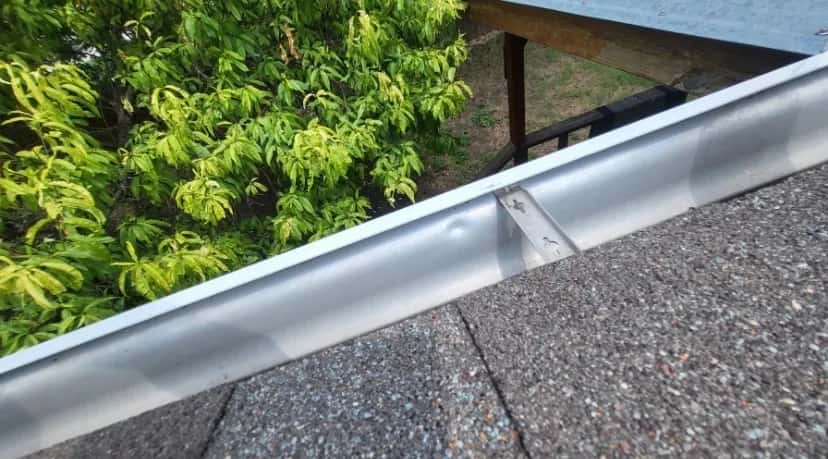
Also, if hail or wind damaged your gutters, they may belong in a covered insurance claim with the roof. Dented gutters and downspouts are often some of the easiest hail evidence to see from the ground. How we document storm damage with your adjuster is on our insurance claims page.
Getting a gutter estimate that makes sense
A fair gutter installation cost comes with a quote that spells out what you're paying for and why the system is sized the way it is. Ask the contractor why they went with 5-inch over 6-inch. Ask where the water goes after it leaves the downspout. If they can't tell you, keep asking.
Texas-RRR is veteran owned, with more than 2,800 projects completed around San Antonio and Austin, and owner Charlie Carreon has been roofing for 30 years. We install seamless gutters, formed to the length of each run, as part of our roofing work, and we look at the whole roof edge instead of just the trough. For a free estimate, reach out to our team or call (210) 802-6906, Monday through Saturday, 7 a.m. to 6 p.m..
Related services
Seamless Gutter Installation from Texas-RRR, with a free estimate before any work starts.

Written by
Owner, Texas-RRR (veteran owned) · 30 years of roofing experience · Team with 30+ years of insurance claim experience · In-house former insurance adjusters · Registered and insured